
Reserve Bank of India (RBI) Governor Sanjay Malhotra stated that preventing second-round effects of supply shocks, where inflation expectations rise due to prolonged disruptions, is the primary role of monetary policy. He also defended the RBI's foreign exchange market interventions, asserting it did not commit to an 'indefensible peg'.

'When there is such an elaborate and a strong process, one would have expected anyone to either place the issues so that they can be addressed or go to the regulator and probably tell them rather than creating a kind of uncertainty for the stakeholders.

India's forex reserves dropped by $1.01 billion to $697.93 billion for the week ended June 20, the Reserve Bank of India said on Friday. In the previous reporting week, the reserves had jumped by $2.29 billion to $698.95 billion.
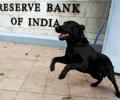
The central bank has nine executive directors, and one of them -- S Karuppasamy -- retired recently. R Gandhi, who was executive director, has now been promoted to the post of deputy governor.

The University of Chicago has conferred its Alumni Award for Professional Achievement to India's former chief economic adviser Krishnamurthy V Subramanian, the first Indian economist to receive the honour since 1941.

Police in Kanpur have arrested a suspected mastermind behind a network of fake firms, forged documents, and suspected hawala transactions worth over Rs 3,200 crore.

Two-factor authentication for all digital transactions, including UPI, is now mandatory in India, as per RBI guidelines, to enhance security and curb fraud.

Only bona fide victims would be compensated by banks within five days of receiving the complaint.

Petroleum Sports Promotion Board (PSPB) and Reserve Bank of India (RBI) will compete in the final of the 87th UTT Senior National Table Tennis Championships after defeating Uttar Pradesh and Karnataka respectively.

India's new manufacturing project announcements more than halved in the fourth quarter of FY26, falling 60 per cent sequentially and 78 per cent year-on-year to approximately 1.7 trillion, driven by global uncertainties, geopolitical conflicts in West Asia, and existing unutilised manufacturing capacity.

Months after picking up 24.21 per cent stake in private sector lender Yes Bank, Japan's Sumitomo Mitsui Banking Corporation (SMBC) has received the Reserve Bank of India's (RBI's) in-principle approval for setting up a wholly owned subsidiary (WOS) in India.

'We strongly believe that anyone with capability and a strong work ethic should have a chance at the top job.'

India's forex reserves dropped by $1.88 billion to $686 billion during the week ended November 28, the RBI said on Friday. In the previous reporting week, the overall reserves had declined by $4.47 billion to $688 billion.

The case for long-term investment in gold, however, remains intact.

Unified Payments Interface (UPI) transactions in India reached a record high in March, driven by increased adoption and global expansion. The system now accounts for 85% of digital transactions in India and is live in eight countries.
Unified Payments Interface (UPI) transactions in India reached a record high in March, with 22.64 billion transactions, marking a significant increase from the previous year and highlighting the growing adoption of digital payments.

Chief Justice of India expresses concern over the increasing number of digital arrest scams, highlighting a recent case where an elderly woman was defrauded of her retirement benefits.

The pickup was driven partly by fresh corporate investment but more by higher working-capital demand.
Airpay Payment Services has partnered with Maharashtra State Co-operative Bank (MSCB) to enable UPI-based digital payments across the lender's network in Maharashtra, aiming to accelerate financial inclusion in rural areas.
The Reserve Bank of India (RBI) has proposed several measures to develop a more conducive framework for the long-term growth of Prepaid Payment Instruments (PPIs), including enhanced transaction security and clearer rules on refunds and grievance redressal.

Benchmark lending rates unchanged with repo rate at 5.25%

Beginning next month, a bank customer can opt for up to four nominees in her or his account with a view to ensure uniformity, and efficiency in claim settlement across the banking system. The key provisions relating to Nomination under the Banking Laws (Amendment) Act, 2025 will come into effect from November 1, 2025, a finance ministry statement said on Thursday.

Fitch Ratings on Thursday raised India's GDP growth forecast for the current fiscal to 7.4 per cent, from 6.9 per cent, on increased consumer spending and improved sentiment boosted by GST reforms.

The government plans to expand its central bank digital currency (CBDC)-based food subsidy programme to Chandigarh, Dadra and Nagar Haveli, and Daman and Diu by June, following its implementation on a pilot basis in Gujarat and Puducherry, official sources said.

The Election Commission has warned against any lapses in maintaining law and order ahead of the West Bengal Assembly elections, questioning the absence of a Narcotics Advisory Committee in the state and directing strict monitoring of financial transactions.

In the wake of the Chinese war, it was felt in some circles that it would be feasible to make a frontal attack on demand for gold in India. Accordingly, the Gold Control Order 1962 was issued, banning the making and selling of jewellery above 14 carats, making it compulsory for gold smiths to be licensed and submit accounts of all gold received and utilized by them etc., The measures met with lot of resistance and criticism.

Fino Payments Bank (Fino) has become the first such entity to get an in-principle approval from the Reserve Bank of India (RBI) to transition into a small finance bank (SFB).

The Reserve Bank of India (RBI) on Wednesday met the long-standing demand of banks by allowing them to finance acquisitions by Indian companies, a move that also expands banks' capital market lending in the country.

'The MPC is likely to prioritise the key mandate, which is inflation, while relying on other instruments to stabilise the currency and bond markets.'

Its strength is set to increase by 3 seats once the current round of Rajya Sabha polls for 27 seats are concluded on June 28.

The top agenda of the meeting includes a review of Tata Trusts representation on the Tata Sons board.

The Supreme Court has urged the Kapur family, including Rani Kapur and Priya Kapur, to resolve their dispute over the family trust through mediation, appointing a former Chief Justice to oversee the process.

Gwadar is viewed as a critical pearl in China's maritime strategy as it would give a permanent logistical footprint near an important choke point - the Strait of Hormuz and the oil rich Persian Gulf, explains Commodore Venugopal Menon (retd).

Wholesale price inflation extended upward momentum for the second straight month, recording at 0.83 per cent in December 2025, driven by an uptick in prices of food, non-food articles, and manufactured items on a month-on-month basis, government data showed on Wednesday. Wholesale Price Index (WPI)-based inflation returned to positive in December, after witnessing a deflationary trend in the previous two months.

India's forex reserves jumped $5.54 billion to $692.57 billion during the week ended November 14 due to a steep increase in the value of gold reserves, the RBI said on Friday.

Maharashtra's Governor and Chief Minister, along with other state leaders, paid tribute to Dr. B.R. Ambedkar on his 135th birth anniversary, recognising his profound impact on social justice, equality, and the Indian Constitution.

'India has initiated a bear market and we will still go lower. It has nothing to do with the economy.'
The Reserve Bank of India's dilemma over rates is its alone.

For every 100 rupees, households invested Rs 45.2 in mutual funds and equities in 2024-2025.

India's foreign exchange reserves dropped by another $2.7 billion to $687.03 billion during the week ended November 7, the RBI said on Friday.
